
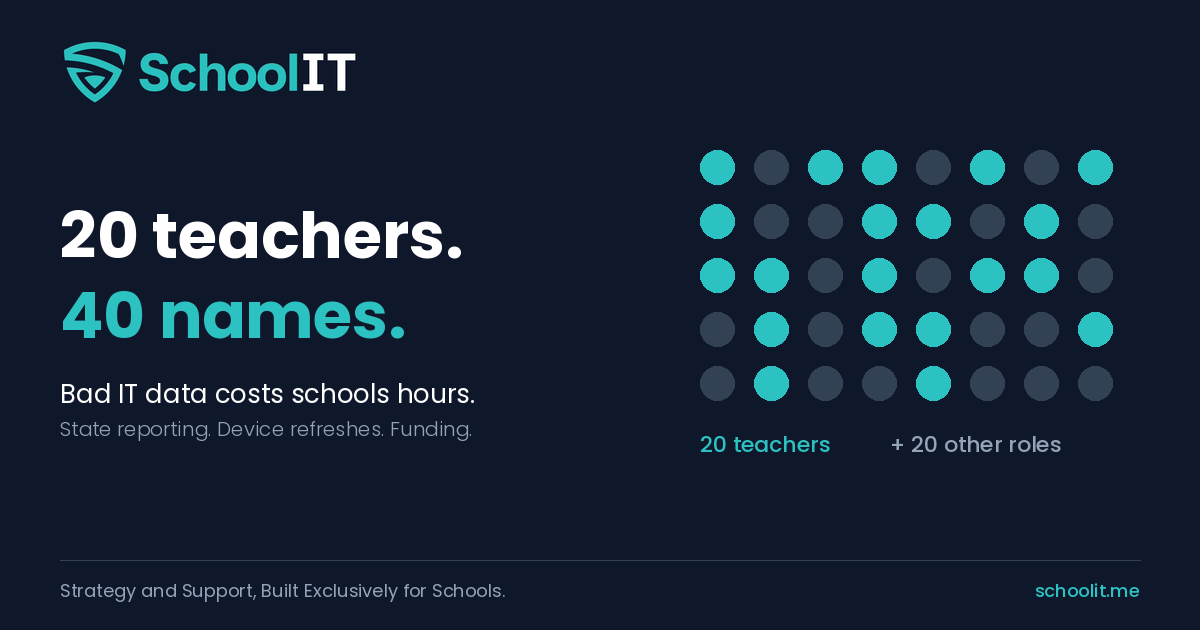
I once pulled a list of teachers from PowerSchool for a building with 20 teachers. The report came back with nearly 40 names.
Administrators, special services staff, and other roles were mixed in with the classroom teachers. Nothing was broken. The system was doing exactly what it was told to do. The problem was how the data had been entered and maintained over the years.
That's when the real work started, and it's a good example of why accurate IT data matters far beyond the IT office.
The Question That Sounds Simple
It was time to order new devices, so the question was simple: who is eligible for one?
Answering it meant knowing exactly who the teachers were, and then knowing which devices they already had, how old those devices were, and where they were. Each of those answers lived in a different system, and none of them agreed with the others.
Devices Don't Stay Where You Put Them
On top of the staffing data, we had lost track of devices that were originally deployed in one school and later transferred to another. They were still in use. They just weren't where our records said they were.
So finding every device that needed replacing turned into a scavenger hunt. A task that should have taken minutes took hours, and the result still needed double-checking.
Why This Goes Beyond Convenience
State reporting. Student information systems feed the reports a school or district submits to the state. When staff roles, enrollment details, or program data are inaccurate, those errors flow straight into the reporting. And because reporting can affect funding, bad data can carry a real financial cost.
Device planning and budgeting. You can't budget a refresh cycle without knowing who gets a device, what they have now, and how old it is. Wrong numbers mean over-ordering, under-ordering, or an emergency purchase.
Fairness. Eligibility rules only work when the underlying data is right. Otherwise some staff get devices they don't need while others wait.
Security. A device that isn't in your records is a device you aren't patching, tracking, or retiring properly.
Knowledge continuity. If the real picture lives in one person's memory, it leaves when they do.
How It Happens
This isn't negligence. In small teams, one person is often handling everything. Roles change, people are hired and reassigned, and devices move between buildings during a busy year. Cleaning up records is rarely urgent until the day you need them.
What Good Looks Like
- Clean role data: staff are categorized in a way that lets you pull "classroom teachers" and get exactly that
- A connected inventory: every device is tied to a location, an owner, and an age
- Transfers get recorded: when a device moves buildings, the record moves too
- Regular audits: a scheduled check catches drift before it becomes a crisis
- Documentation: the process is written down so it survives staff turnover
When the data is right, the device order is a ten-minute report instead of an afternoon of detective work.
Strong Data Supports Your On-Site Team
Your tech staff and office staff already know where the gaps are. A clean, connected system gives them time back and gives your superintendent numbers they can trust for budgets and reporting.
Not Sure How Reliable Your Data Is?
If pulling a simple list ever turned into a puzzle, that's worth fixing. Let's take a look together.
Adam Murray
Founder & Principal IT Director, SchoolIT